
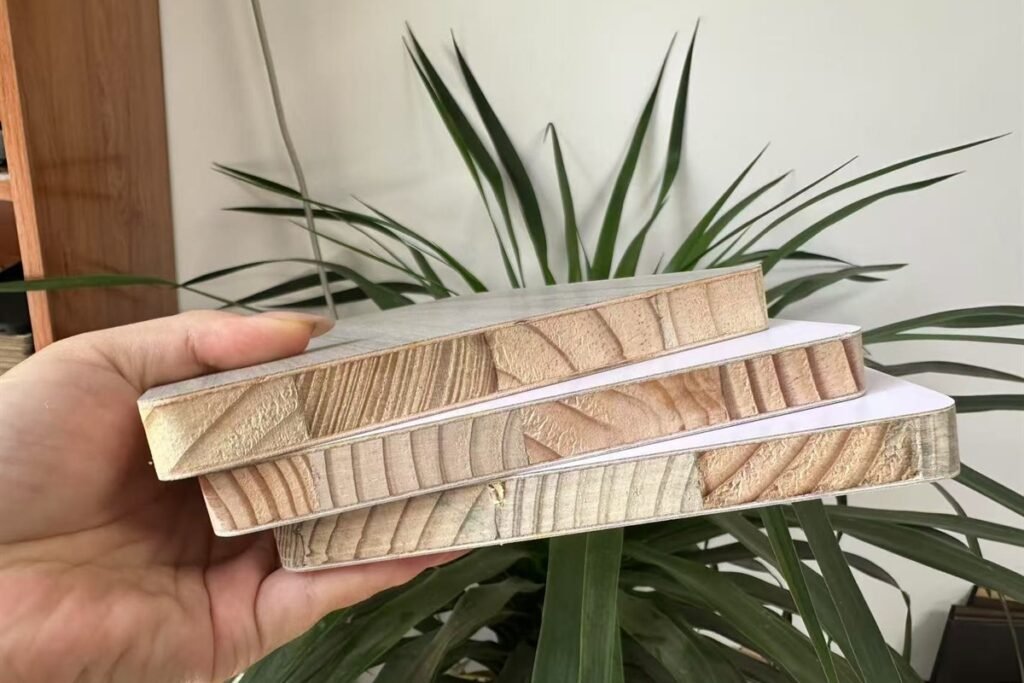
A cut sample helps buyers inspect the core beneath a decorative face.
AILISHI · PANEL SELECTION
A furniture panel can look right on a screen and still be the wrong specification for a production line. For importers, cabinet manufacturers and project buyers, the useful question is how a particular panel will fit the intended component, processing method and purchasing plan. This guide compares veneer-core melamine plywood with solid-strip-core melamine blockboard, using practical checks you can include in a sample review.
1. Look beneath the decorative face
Veneer-core plywood is built from thin wood veneers arranged in layers, normally with adjacent grain directions crossing. Blockboard uses a central assembly of solid wood strips with facing layers above and below it. Both may carry decorative surfaces, so a white or woodgrain face does not identify the core on its own.
The USDA Forest Products Laboratory describes how plywood construction affects its properties, including the role of veneer arrangement and bonding. This is useful background, but the specification of an individual product still matters. Inspect the edge of the actual panel rather than assuming that every product with the same category name will perform alike. See the USDA Wood Handbook chapter on wood-based panels.
2. Start with the component you need to make
Write down whether the panel will become a cabinet side, shelf, door, divider or display unit. Record the finished component dimensions, how it will be supported, where hardware will sit and which surfaces customers will see. These details make the supplier discussion more useful than a request for a general-purpose furniture board.
For a shelf, evaluate the intended span and load in the actual design. For a door, review its dimensions, fittings and assembly requirements. Avoid treating a core species name or panel thickness as a complete design specification. Where panel weight is important, request the actual weight for the chosen configuration instead of estimating from a product photograph.
3. Review samples with your production team
Ask for a representative cut sample that shows the decorative face, an unfinished edge and the core structure. Identify it with a sample reference so the same selection can be discussed during quotation and production. Review more than one location on the sample where practical.
Use your intended saw, drilling method, edge treatment and fittings for a small processing trial. Check the resulting cut edge, the appearance after edge banding and the assembly around hinges or connectors. Record what is acceptable with photographs and written notes. A sample is most useful when it helps define an approval process, rather than serving only as a color swatch.
4. Specify the surface separately
Core selection and decorative selection are related purchasing decisions, but they should be recorded separately. Define the face design, sheen, grain direction and whether the back should match the front. If several furniture components will be visible together, assess the samples side by side under the lighting you expect to use.
Ask how the exposed edges will be finished and whether matching edge materials are part of the order. A decorative face alone does not describe every exposed surface of the finished furniture. Keep a reference sample available for the production and receiving teams.
5. Compare quotations on the same basis
Give each supplier the same product description, dimensions, thickness, quantity, face/back requirements, packing needs and delivery destination. Ask which tolerances and supporting documents are included in the offer. If a performance requirement matters to the project, identify it explicitly and request evidence for the selected construction.
Compare the complete proposed order, including sample approval, processing needs and packaging. A lower unit price is difficult to evaluate when one quotation describes a different core, back face or packing arrangement.
Discuss your panel requirements with Ailishi
Ailishi International Trading Co., Ltd. supplies decorative plywood and blockboard options for business buyers. Share your component design, preferred finish, dimensions and quantity so our team can help you review samples and prepare a quotation.